

If you're reading this, you love olives. Olives, the fruit of the gods, are incredibly easy to cure with salt, albeit it does take a fair amount of time before you can indulge in their loveliness.
In this article, I will explain how to cure olives with salt, the pitfalls of using food-grade lye, and some background information on the Arbosana olive tree, which produces a fantastic Spanish olive.
If you live in an area where you can grow your olive trees, consider yourself lucky! Olive trees are easy to grow. They require little upkeep and are masters of survival, especially in dry climates. At the end of the growing season, you'll be rewarded with a harvest of delicious olives. (Fig 1)
You can still cure your olives even if you don't own a tree! There are a lot of sellers from California offering olives for sale on the Etsy.

Growing the olives, however, is only half the process. You need to learn how to cure olives. Depending on whom you speak to, everyone has a different process. It's like asking ten people how to make a pizza—everyone has a different method.
Last year, I tried curing olives with lye. The results could have been better. After giving the entire process additional thought, I decided this year to forego lye and instead try curing with a brine solution. I opted for the lengthier process of curing olives in a brine solution to compare the outcome with olives cured using lye.
For this article, I will focus on curing Arbosana olives. Why Arbosana? Because that's the type of olives I grow. Please don't fret; most of what I cover applies to most other varieties of olives, except California black olives.
If you live in an area where olive trees are uncommon, you can buy a tree online and have it shipped to your home. I purchased my olive tree from Tropical Mango Nursery in Apache Junction, Arizona. The last time I checked, they offered seven varieties of olive trees, each for $24.99, from their Etsy store.
Planting olive trees is forbidden if you live in Maricopa County, AZ! Sounds ridiculous, I know, but it's the law! Many years ago, the county decided the increase in pollen allergies was due to the numerous olive trees planted by the county. The country removed the trees and passed an ordinance outlawing the planting of new fruit-bearing olive trees. I would not worry about this. If you want to plant an olive tree (and live in Maricopa County), don't plant one in your front yard. 😉
Arbosana Olive Tree—a Spanish Cultivar
Native to Spain, the Arbosana olive (Olea europaea) (Fig 2) is most commonly used for olive oil production. These trees are incredibly drought-tolerant and do well in even the hottest temperatures.
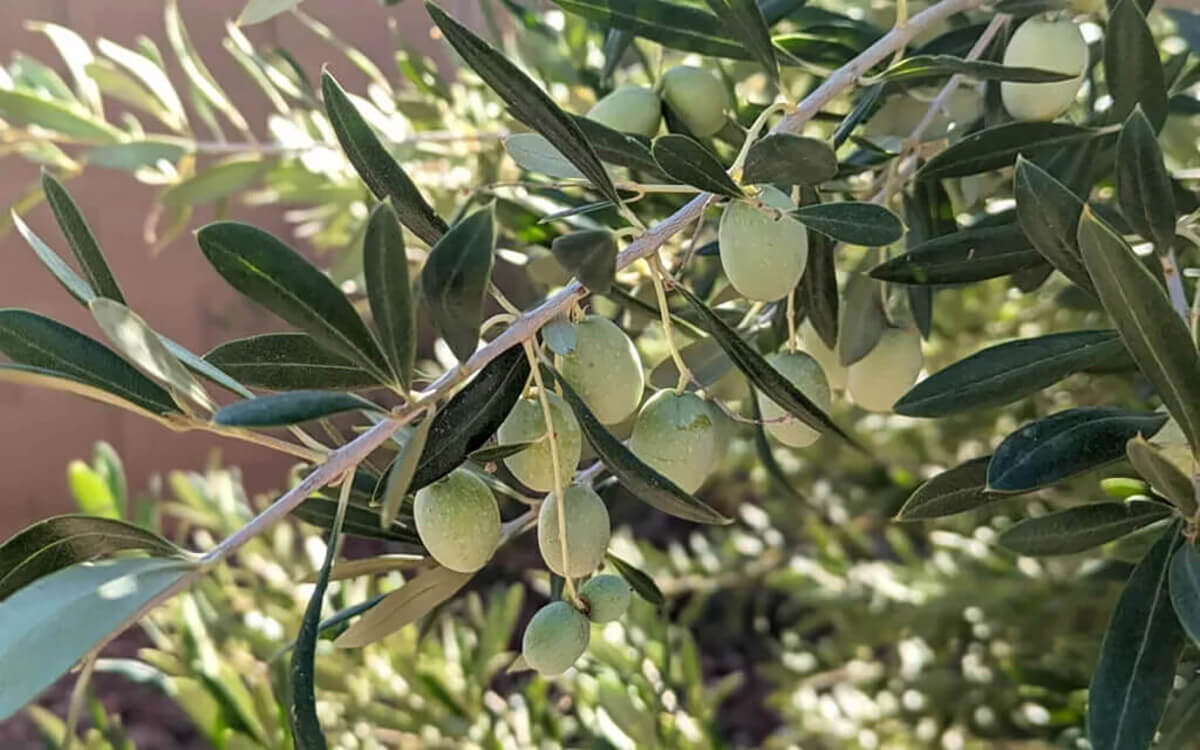
The Arbosana olive tree is known to produce a high number of olives. From the 5th year on, a typical tree can yield about 150 qt. That's 150 (1 quart) Ball canning jars.
During a recent heatwave, Phoenix experienced 31 consecutive days of 110 degrees Fahrenheit or higher. The olive tree is one of the few plants I own that was seemingly unaffected by the extreme temperatures.
Beyond occasional pruning (after the olives have been picked), the tree requires very little upkeep. I typically water it by hand once per week.
The Arbosana olive tree is an evergreen tree that will continue to grow throughout (most of) the year. In May, the tree produces small white flowers, which are self-pollinating. (Fig 3)

The olives are typically ready for harvest in late October. If you want to cure green olives (unripe), they are ready to harvest once a few have turned purple (ripe). (Fig 4) The more unripe the olive is, the higher the levels of oleuropein, a compound that makes the olive bitter.
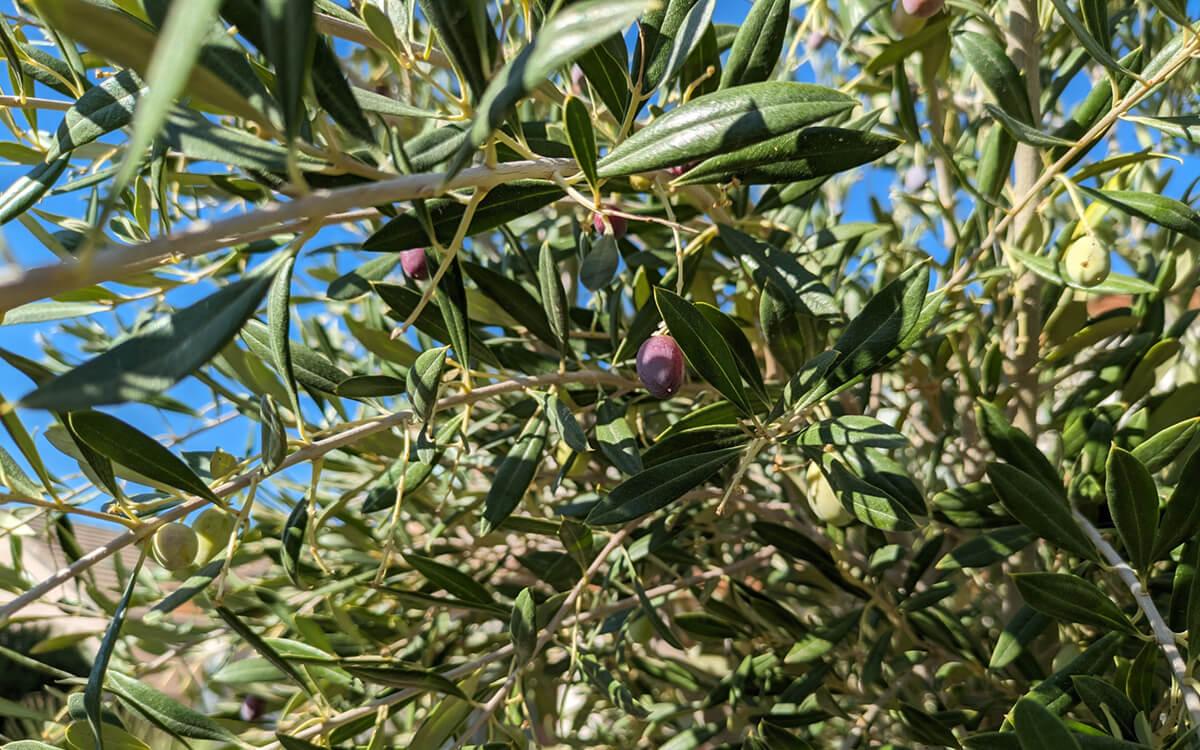
Left unpicked, all the olives will eventually turn a dark purple. You can cure ripe olives (dark purple), but once they ripen, they quickly go bad if not removed from the tree. You'll also compete with the local birds who have a taste for fresh olives.
Ripe olives take less time to cure than green (unripe olives), because they contain less oleuropein, an extremely bitter compound (phenolic acid) that makes them inedible. Oleuropein is removed from the olive during the curing process by diffusing from the fruit into the surrounding brine solution.
Fruit production can be increased by planting the Aborsana tree near an Arbequina olive tree (Olea europaea). When grown close to an Aborsona tree, cross-pollination occurs between the two trees, resulting in increased olive harvest.
This season, I harvested about 15 pounds of olives from a tree no more than 6 feet tall, more than double the harvest of the previous year.
How to Cure Olives (with Salt)
As you read through this section, please remember that each time you cure olives, you will probably make minor tweaks to the process. Over several years, your recipe will look quite different from what I shared.
When I was in the pizza restaurant business, a friend in New York swore the dough in NY pizza was better because of the water used during the dough-making process. Others I have spoken to say that's nonsense! To this day, I still don't know which opinion is correct.
My point is that many variables will affect how your cured olives turn out. The type of water, for example, can have an impact. So can the type of olive, the temperature of the area where you store the olives, the type of salt, and so on.
Develop a method that produces olives you enjoy eating. Just as no two pizzas are the same, the olives you make will be your own.
After picking your olives, the first step is to rinse them with cold water. Pick through the olives and remove any over-ripened, bruised, or insect-damaged.
Before you start, ensure you have plenty of salt (non-iodized) and a stoneware, plastic, or glass container to soak the olives. (Fig 5)

There's some debate about what type of salt is best for curing. To keep things simple, you can use any salt except table salt. I used kosher salt for the first three days of the curing process. When I ran out of kosher salt, I switched to pickling salt. The only difference between kosher and pickling salt is the coarseness. Pickling salt dissolves more quickly.
I've also tried Sosalt Da Mare Di Traoani, sun-dried Sicilian sea salt, recommended by a friend. I did not notice a difference between it and kosher salt in the taste of the olives.
I use a three-gallon stoneware crock from Ohio Stoneware. I dislike plastic because it can leach chemicals into the brine. Glass containers work well, but I am clumsy!
Curing olives is easy! Here's how I cure Arbosana olives. This set of instructions can be used to cure most types of olives.
For those of you wondering where the photo of my finished olives is, well, they are taking a bit longer than expected to complete the brining process.
Cured Olives
Instructions
- Sort the olives, removing any that are bruised or over-ripened.
- Rinse olives in cold water.
- Place the olives in a container – I use a stoneware crock.
- Pour enough cold water into the container so the olives are covered.
- Strain the olives from the water using a colander, ensuring you reserve the water. You’ll need to know how much water is in the container.
- Measure the reserved water. You need to calculate the amount of salt to add based on the (amount of) water you poured from the container.
- Fill a large pot with the same amount of (reserved water) in step 6. Add 3.5 oz. of salt for each 2 pints of water. Bring the water to a boil and ensure the salt has dissolved. Remove the water from the heat and let it cool to room temperature.
- Make three small slits in each olive using a small serrated knife. The slits help the brine penetrate the olive.
- When the water has reached room temperature, pour it into a container, followed by the olives. Place a plate on top of the olives to keep them submerged.
- After 24 hours, repeat steps 7 and 9, discarding the previous day’s brining solution and replacing it with a free brine. Repeat this process for about ten days. Taste an olive to test for bitterness. If the bitterness is gone, you’re ready for the next step. If the olives still taste bitter, make a new bring solution and let them soak for a few additional days—taste-testing them each day.
- Make a final solution to store your olives in. Repeat the brine solution made in the previous steps, or use a 50:50 mix of water and white vinegar.
- Put the olives into sterilized jars (I like Ball canning jars). Pour the brining solution (or water and vinegar mixture) into each jar. Pack the olives up to two fingers below the edge of the lid. Fill this space with extra virgin olive oil and seasonings.
- Store the jars in a cool place for up to 6 months. You can also store them in the refrigerator for a year.
Notes
- Rosemary, thyme, oregano
- Citrus leaves, lemon peel
- Coriander
- Dried chilies
- Garlic cloves
How to Cure Olives (with Lye)
I decided to include instructions on how to cure olives using lye for those looking for a quicker process. I may revisit this process next year, albeit with some modifications.
Food-grade lye has several uses, including curing olives and making pretzels, canned mandarin oranges, and hominy. Lye, for example, gives pretzels their trademark shine and mahogany color.
Many commercial olive producers use lye in the process of curing (especially canned black olives). Lye removes oleuropein, the compound that produces the bitterness, by riping the olive unnaturally. Lye also strips away some of the olive's nutrients.
When lye is used to cure olives, it removes the extreme bitterness from the olive. Lye also enhances the color and gives olives a smooth, buttery-like flavor.
Food-grade lye (sodium hydroxide) is "pure lye"—with no added contaminants. Anyone who has worked in a restaurant or used oven cleaner at home is probably already familiar with lye. Lye is a common ingredient in cleaners used to boil out fryers or oven cleaners. Because of its corrosiveness, lye easily removes baked-on oil and grease. It's also used as an ingredient in toilet bowl cleaners. ¡Ay, caramba!
Herein lies the problem with lye. (Fig 6) Not only does it do wonders for grease, but it can easily remove human skin, resulting in nasty burns.

I attempted to cure my first olive harvest the prior fall using lye. The results were disappointing. I followed the recipe for soaking the olives in a lye bath for 12 hours, followed by a rinse and a second 12-hour soaking in lye.
In hindsight, the instructions were flawed. A second lye bath is unnecessary. The second dose resulted in the lye stripping away the thin exocarp on the olives, as though they were molting.
I may revisit this process next year, albeit with some modifications. I prefer the bright green color of olives cured in lye to the dull, dark green color of brine-cured olives.
If you try curing with lye, remember not to use any containers (or spoons) made from aluminum! When mixed with aluminum, lye creates highly flammable hydrogen gas, which can also eat a hole in the aluminum container.
The exocarp is the tough outer layer of skin on fruit. Yes, olives are considered a fruit! The exocarp covers the mesocarp, the fleshy inside portion of an olive.
Olives Cured with Lye and Brine
Instructions
- Rinse freshly picked olives in water and place them in a large stoneware or glass container.
- Mix 1 tablespoon of lye with 1 quart of water per 4 cups of olives.
- Soak the olives for 12 hours. Use a plate on top of the olives to keep them submerged.
- Drain the olives and soak them in a container of cool water for 4 to 6 days, changing the water several times a day.
- Taste the olives to see if any trace of the lye flavor remains. If the olives still taste soapy, soak them until the soapy taste dissipates. Pay close attention to the color of the water. When it is clear, the remaining lye has been removed from the olives.
- Prepare a brine using 3/4 cup of salt added to a gallon of water. Add the olives to the brine and let sit for one week. Keep the olives submerged using a plate. At the end of a week, prepare a new brine, increasing the amount of salt to 1 cup of salt per gallon of water.
- Add some flavor to the mix—white vinegar, rosemary, garlic, chili peppers, bay leaf, etc. Place the olives in Mason jars, and pour the brine over the olives. Let the olives rest in the brine mix for about two weeks. Store in a cool place or the refrigerator.
Notes
Additional Reading
Reducing Phenolics Related to Bitterness in Table Olives - Hindawi
Oleuropein - Science Direct

Ask Me! 
Need some expert guidance? Shoot me a message, and I'll provide actionable, free advice to solve your problem.
Message Me