

If you live in a desert or an arid environment, you can easily design a landscape that mimics a natural desert ecosystem.
It's not necessary to hire a landscaper! You can do all the work yourself and gain personal satisfaction by doing things without outside help.
Landscaping that mimics an ecosystem foreign to the area in which you reside is a bit offsetting. In my neighborhood, there are homes with landscaping that appear as though they were picked up and transported from the suburbs of Jersey.
Open your eyes. As you travel around your community, note nicely landscaped property. Take a walk through your neighborhood. You'll see things you never noticed while driving.
Take a ride to a more upscale neighborhood. Homeowners with more money tend to hire professional landscaping companies. While certainly not always the case, wealthy homeowners tend to have yards that reflect the value of their homes. Use this as inspiration for your project.
On a day trip to Carefree, AZ, I stumbled upon a boutique shopping center with a fantastic array of desert plants—most of which I had never seen before.

You don't need a "master plan." Instead, visit a few local big box stores and nurseries to determine the best place to buy the plants you would like for your yard.
You don't need a huge budget. Instead, select the plants you like and spend a little extra on some "showpiece" plants. If you plan on shopping at Lowes or Home Depot, you won't find any plants over a few years old. You'll need to visit a nursery to see larger, older specimens. These are the plants you spend a little more on!
If you haven't visited a nursery recently, don't be surprised by how expensive most items are. In most cases, you will pay a premium over anything offered at Lowes or Home Depot. Remember, it's not a fair comparison between the plants at a nursery and those at a big box garden center.
Professionally run nurseries raise the plants they sell and are staffed with experts who can help answer any questions. Moon Valley Nurseries, a local chain of nurseries in Arizona, even offers delivery and planting of large trees.
When I bought my home in Arizona, the first thing I did was remove plants I disliked. In front of my house, I had a substantial Mexican bird of paradise (Caesalpinia pulcherrima). When in full bloom, these are beautiful in the spring and summer; however, they are not very attractive in winter.
Next, I removed plants that did not fit, such as rose bushes.
Finally, any plant struggling to survive the intense heat was removed.
Gradually, over time, I replaced the plants I removed with newly purchased shrubs, cacti, and palm trees. As I added new plants, I envisioned how things would look in a few years as the plants matured. I took note of areas that looked empty and used this as an excuse to buy more plants! : )
When considering the purchase of new trees, remember that nurseries and big box stores sell deciduous trees. If you live in an area that is warm year-round, you probably don't want a tree that loses its leaves in the winter.
Deciduous trees lose their leaves in the fall. Evergreen trees keep (most) of their leaves year-round. Evergreen trees can lose some leaves in the fall, especially during cold spells, but the remaining leaves stay green.
Winter arrives in Phoenix much later than most of the country, but most deciduous trees will be without leaves just before the new year.
A few examples of deciduous trees you probably will find for sale in the Phoenix area are red plum, fig, various varieties of ash trees, and crape myrtle.
Mimic a Natural Desert Ecosystem
For the most dramatic effect, consider your yard a natural extension of the desert. Design a landscape that mimics a natural desert ecosystem.
Deserts aren't flat, contrary to popular belief. Build hills and valleys with topsoil and rocks. Golf courses and retirement communities, which are too numerous to count in this area, are excellent places to visit for inspiration.
In the area in which I live, homes don't have well-manicured spreads of grass. Grass lawns are frowned upon because they use a lot of water and are not native to this area of the country. Instead, most homes use crushed rock.
You will only have a choice in the rock color if you buy a new home. Removing the existing rock the previous homeowner selected and replacing it with a different color is a vast project and expensive.
When I decided to add more rocks to my yard, I mistakenly bought the incorrect color. With 10 tons of rocks in front of my house, I had to figure out how to make my "mistake" work. Instead of covering over the existing rock, I decided to mix the new rock with the existing. The result was an interesting effect that mimicked nature instead of one continuous swath of a single color.

Try placing large boulders randomly throughout the landscape. Boulders can be expensive. Try searching Facebook Marketplace or OfferUp for boulders. Homeowners often no longer want these items and are willing to part with them for very little. If you go to a store that sells landscaping boulders, you can expect to pay a few hundred dollars a piece for large boulders.
If you just purchased a home in a new development, look for trucks roaming through new neighborhoods selling boulders. You can usually get a good deal!
Avoid detectable patterns. Arrange boulders or plants in no discernible pattern—for example, one boulder on each side of the driveway entrance.
Plant trees and taller plants closer to your home and shorter cacti and shrubs closer to the street. Note the location of your windows and plan accordingly. Avoid planting anything that may eventually grow tall and block the view from your windows.
My artist father once told me that very few things in nature occur in "ones." Instead of planting one barrel cactus, buy several and arrange these throughout your yard.
Tools to Make Landscaping Easier
You don't need to spend a lot of money on tools. Most of the tools I use are inexpensive.
To haul rocks or large plants, you'll need a sturdy wheelbarrow. Only buy one that has a manageable capacity because you won't be able to lift it. A wheelbarrow with a metal tub is better than plastic. Plastic can break; if you plan to store it outside, especially in a hot climate, it will eventually become brittle and crack.
A pick axe is a must-have in an arid desert climate. The soil in desert environments tends to be hard and compact until you get through the first layer. I prefer axes with a wooden handle to those with composite materials.
Once you're finished using the pick axe to break through the soil, you'll need a solidly built shovel to remove the soil and dig a deeper hole. Rounder shovels are better because as you dig, only the rounded part of the shovel will initially need to penetrate the soil.
A pair of heavy-duty gloves are a must. Leather gloves better protect you against thorns on cacti, citrus, and (some) palm trees.
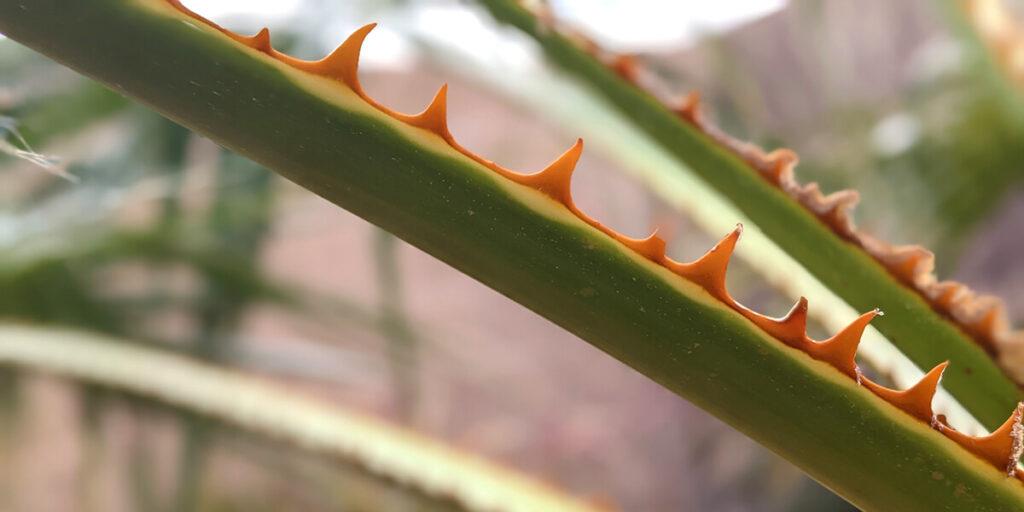
Mexican palm trees have a ferocious set of "shark-like" teeth (thorns) on the petiole that can easily tear through the skin and leave you hooked to the plant. If you've ever had a fishing hook stuck in your hand, it feels about the same! Once the palm reaches about 22 feet, the thorns disappear. This is because herbivores at one time, by standing on their hind legs could reach as high as 22 feet to eat the plant.
Because the ground in Arizona is very hard, I've found most plant stakes can't penetrate the soil. I like to use iron rebar. Home Depot, for example, has various rebar of various lengths for sale. I prefer to buy a few long sticks and cut each to the desired size with a hacksaw.
An inexpensive hack saw is also an excellent tool for cutting off palm tree petioles. Hand trimmers can't open wide enough to cut most palms or cacti.
A hack saw is also a good tool for trimming prickly pear or bunny ear cacti. Because cacti are mostly water, a saw will easily cut through the pad. If you own a reciprocating saw, these work as well as a hacksaw, if not better.
If you live, for example, in the Phoenix region, most plants continue to grow year-round. This means you'll need to use a pruning shear regularly to keep up with the growth. I've been using a pruning shear by Fiskars. They are inexpensive and work well for even larger tree branches.
Maintaining Your Newly Landscaped Yard
After landscaping is complete, it's a good idea to consider regular maintenance. Many plants grow year-round in areas such as Phoenix, so this means regular trimming, removal of dead growth, and fertilization.
You don't need to spend much time maintaining your newly landscaped yard. An hour or two most weekends should be fine. If you enjoy being outdoors like I do, a "project" or two always awaits you.
Choose wisely if you plan to hire a company to maintain your landscaping. Most landscaping companies I have seen work in my neighborhood leave much to be desired. Most companies that call themselves landscapers in this area should instead refer to themselves as groundskeepers.
The landscapers I have observed typically do a lot of over-trimming and blowing with leaf blowers. I can easily spot the properties in my area that use "landscapers."
The trees and shrubs are trimmed like a ball or rectangle. A neighbor of mine calls this the "Sun City look," named after homes in a local retirement community named Sun City.

Instead of a landscape miming a natural desert ecosystem, you'll have a yard that looks more like an English garden!

Ask Me! 
Need some expert guidance? Shoot me a message, and I'll provide actionable, free advice to solve your problem.
Message Me