
Solar panel leases are bad for homeowners. Most of the benefits of a solar panel lease program are received by the company installing the panels.
As a homeowner, you may receive a reduced electric bill; however, the company that owns the panels receives all the tax credits. To make matters worse, you are typically stuck making a monthly payment to the solar company for 20 years.
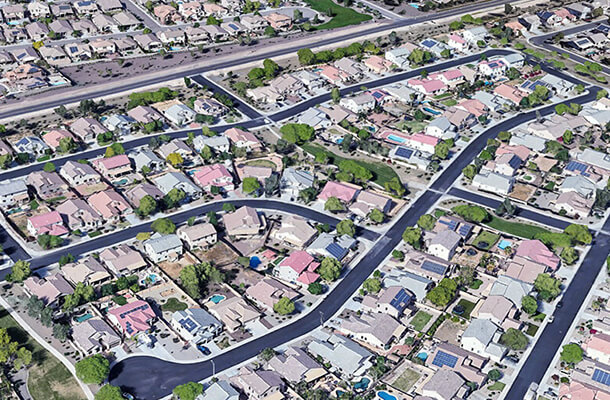
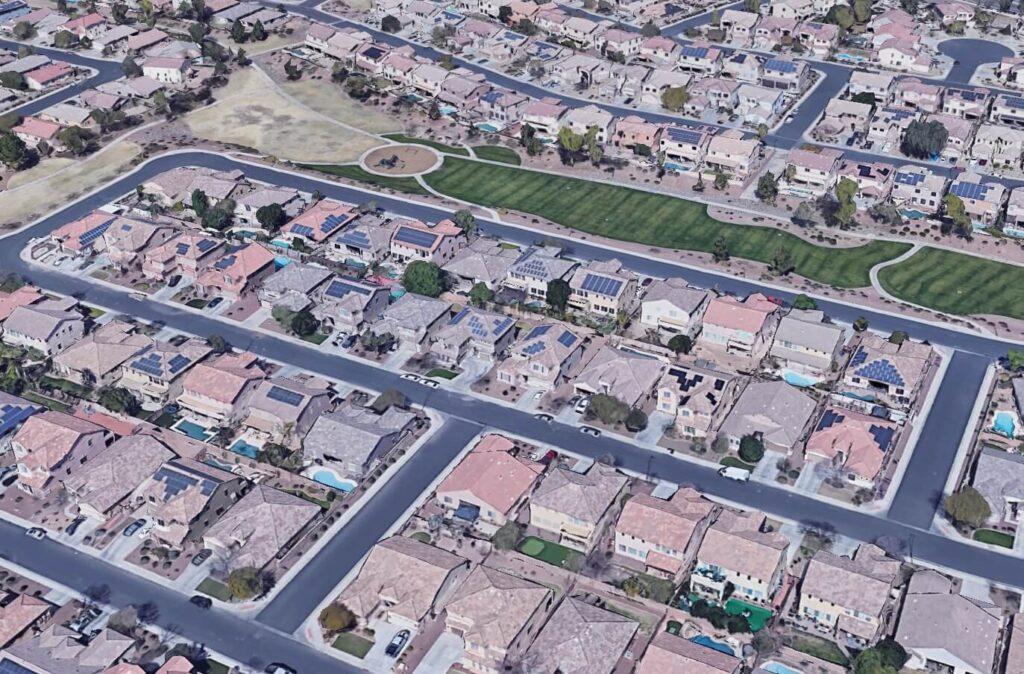
However, looking at the community where I live, it's easy to assume many homeowners feel different, evidenced by the number of solar panels on homes.
My Experience with Solar Companies
When I moved to Arizona, I called several solar companies for estimates. The companies I spoke to are some of the biggest players in the Phoenix metro area.
My only goal was to lower my electricity bill. Pretty simple!
About 30-40% of the homes in my neighborhood have solar panels installed on them. I naively thought if so many others have solar, it must be a good thing.
Here's what I found out. Solar panel leases are bad!
Here's why. When you sign a lease (most of the leases I looked at were 20 years) the roof belongs to the solar panel company for the duration of the lease. The company has a lean on your roof. Your roof belongs to the company you signed a contract with until you fulfill the obligations outlined in the solar panel lease contract.
You cannot sell your home to a buyer unless they agree (and get approved by the solar company) to take over the lease.
In a hot real estate market, waiting for the solar panel company to call you back and approve the new lease might take several days or longer. In the meantime, the potential buyer might find another home to buy or simply not want to wait.
The salesman who visited my home was very aggressive. I only agreed to sign the contract because of a 20-day opt-out clause. In other words (after signing), I had 20 days to change my mind.
The job of a salesman is to sell. Your job as a homeowner is to take the time and carefully think through the sales pitch.
A few days later, after several hours of research, I found most of what the salesman told me to be false. He made several claims which were total lies or just ignorance on his part.
When I asked, for example, where the solar panels are manufactured, he told me they are made in Germany. I discovered that while engineered and designed in Germany, the panels are manufactured in China.
After discovering several inconsistencies in his sales pitch, I decided to cancel the contract via email. You can read the entire contract here.
How a Solar Panel Lease Can Prevent Your Home from Selling
If a buyer wants to purchase your home but does not want the panels, you have a few options, none good.
- Buy out the remainder of the lease from the solar company and offer your home to the buyer with no lease
- Ask the buyer to help you pay off the lease
- Remove the panels and take them with you to your new home
- Buy out the lease and remove the panels
- Lower the price of your home as an incentive to get the home buyer to accept the solar panel lease
- Find a new buyer
A neighbor who recently sold their home had to take the solar panels off their roof (at his cost) before the buyer would agree to purchase the home. He had only owned the home for two years and brought the solar panels with him because the buyer of his previous home also declined to take over the solar panel lease.
After a rainy day, the new homeowner discovered his roof was leaking in several spots. The solar panel company (after removing the panels) failed to patch the holes drilled into the roof tiles.
A battle ensued between the home inspector, the real estate agent (seller), the solar company, and the new homeowner regarding who was responsible for repairing the roof and fixing the damaged drywall.
Moving Solar Panels isn't Easy (or cheap)
If you plan to move out of state, there is a good chance the company that installed the panels will be unable to help you. If the new buyer refuses to take over the lease, you will either have to buy out the lease or take the panels with you.
Moving the panels to another state (or even a long distance within a state) is challenging. You will have to remove the panels at your own cost (and pay for the repairs to the holes in your roof) and the cost of transporting the panels, inverter, and other equipment to your new home.
You'll also have to pay for them to get reinstalled, obtain a new permit, check local ordinances, and find a solar company that will agree to allow you to use your panels.
In most cases, the warranty on your panels will be voided.
Finally, you need to consider how much the new utility company will pay (you) to export the electricity your system generates back to the grid—called net metering. Net metering is the energy received from the utility company minus the excess amount you send back to the grid.
You Won't Qualify for Tax Credits
When you have a solar panel system installed on your home, the federal solar tax credit of 30% belongs to the leasing company, not you! You are not entitled to the tax credit unless you purchase (own) the system. Solar leases and PPAs (purchase power agreements) are not eligible for the tax credit.
Because the solar company owns the panels (you, as the homeowner, are the leasee), they receive the tax credit. The solar company uses the federal tax credit to help offset its costs. In some cases, a solar company may use some of the savings they receive from the tax credits to help lower the cost of your monthly payment.
In addition, if you lease solar panels, you will not be eligible for state or local solar incentives. These instead will go to the solar panel company.
The 30% federal solar tax credit is only available to homeowners who purchase (financed or cash) a solar panel system. If you don't have enough tax liability to claim the 30% credit in one year, you can roll over the remaining credit to future years.
If you don't owe any federal tax at the end of the year, the IRS will not refund you a check for the 30% credit. However, if you owe taxes in a future year, you can apply for the credit, currently up to 2034.
You Won't Save a lot of Money on Your Monthly Bill
In my case, one of the solar companies I met with looked at my previous year's energy usage. Based on the total kilowatts used, they determined I needed a system that would generate 10.5 kilowatts (kW).
At the time (2016), the monthly lease cost would have been $125/mo., plus a "grid access fee" from my local electric supplier, APS. I don't recall the "grid access fee," but for the sake of argument, let's say it was only $10. That puts my total cost per month at $135.
Currently, I take advantage of the budget billing plan offered by APS. Budget billing sets my monthly bill at $175/mo. Without budget billing, the amount due in July might be as high as $400-500. The amount was less than $80 per month in the fall and winter before using budget billing.
Since I switched to budget billing, my monthly cost of electricity has dropped every year.
My cost of electricity for 2022 was $2,136. Had I owned a leased solar panel system, my cost would have been $1,956 (year eight from the monthly lease payments schedule) (including the grid access fee). That's only a difference of $180 a year or $15/mo.
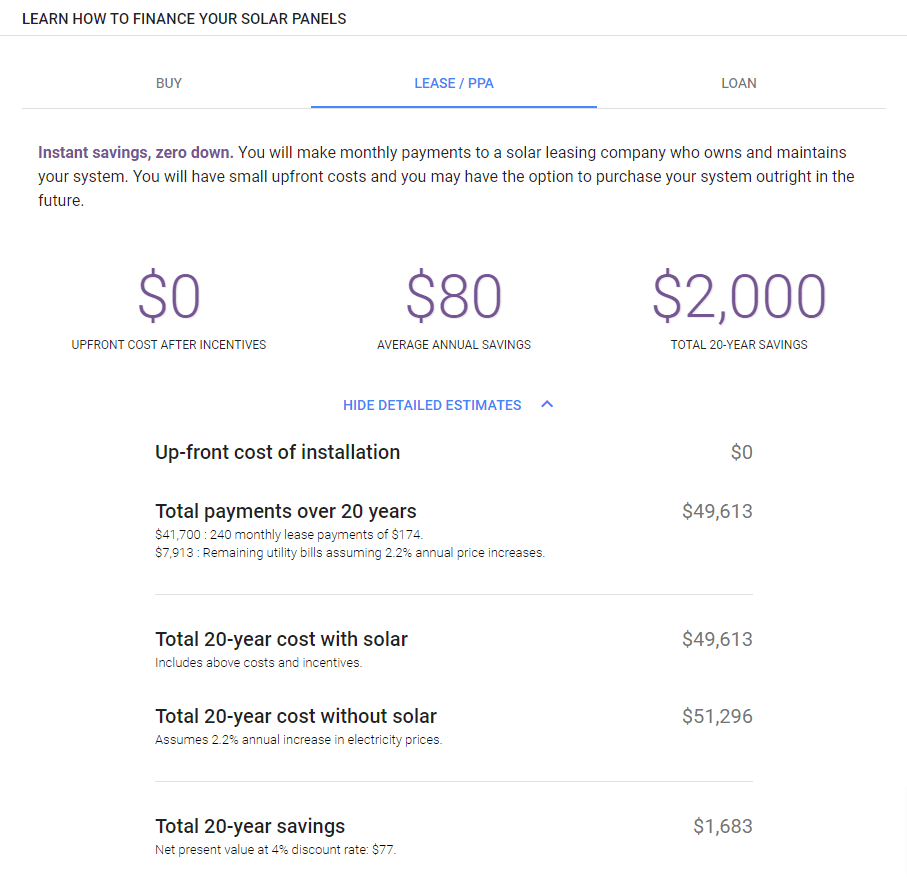
For comparison purposes, Google Project Sunroof estimates my savings over 20 years with a solar panel lease program would be only $1,683. Google quoted a monthly lease price of $174/mo, which is $1 less than what I currently pay for electricity.
For some homeowners, saving $180 a year makes a difference. In my case, the math needed to make more sense.
If I were to install solar panels on my home, I would only do so by purchasing the system outright. Buying a system only makes sense if you plan to stay in your home for at least ten years beyond the installation date.
If you stay in one place for less than a few years, purchasing a solar panel system makes about as much sense as leasing.

Ask Me! 
Need some expert guidance? Shoot me a message, and I'll provide actionable, free advice to solve your problem.
Message Me