

In my neighborhood stands a house with landscaping that could be charitably described as a blank canvas nobody bothered to paint. Every time I stroll past, I can't help but mentally play an episode of 'Yard Crashers' and imagine unleashing a team of landscapers. (Fig 1)
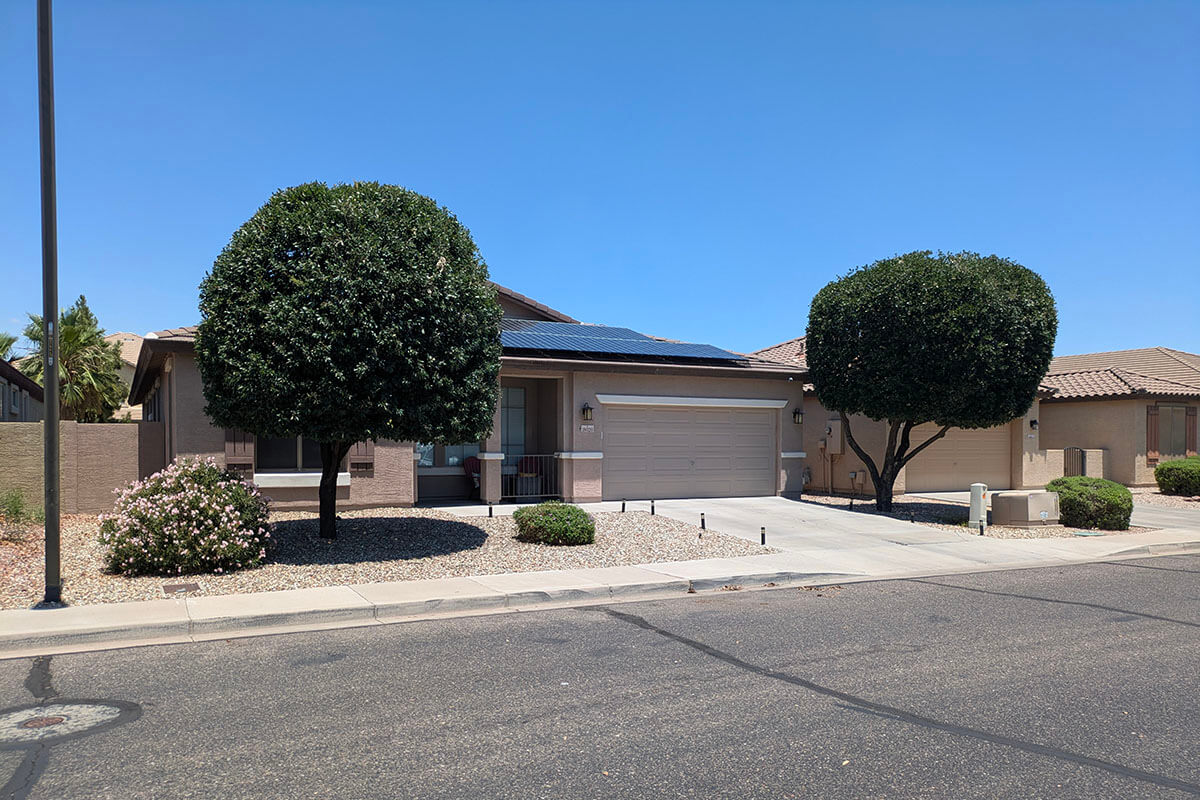
I decided to play digital landscaper and give the neighbor's house a virtual makeover using an AI-generated landscape design. I wanted to see how easily, if at all, AI could transform a landscape, including the use of native, low-water plants.
I am often asked how people can make their yard look nicer. The truth is that most people are overwhelmed by the idea of landscape design, so they either plant a few random shrubs or, worse still, do nothing beyond what the previous homeowner did. Forget about curb appeal. It's about having pride in the place where you live! At least that's how I see things.
Here's where AI landscape design comes into play—offering a fresh, low-effort way to visualize and plan a stunning outdoor space without the usual head-scratching and costs associated with landscaping design apps.
I uploaded a photo from my phone of the neighbor's house to ChatGPT. I asked: "Could you landscape this yard with desert plants and small hills, intermixed with a few boulders?"
I was amazed at how close the AI landscape design resembled what I had in mind. It was not perfect, but changes are easy enough to make. Or are they? As intelligent as AI is, it can also be estúpido! It does not work well with changes. The AI software I have used in the past, in general, will make the changes you requested, but it often modifies different parts of the image that you did not intend to edit. There is an art to learning how to prompt AI.
The transformation is pretty damn good! The hills are about the right size, and there's a nice mix of desert plants. After looking at the image for a few minutes, I decided the lollipop-shaped emory oak (Quercus emoryi) trees had to go. They look more like something from the Oxford Botanic Garden than the Sonoran Desert. (Fig 2)
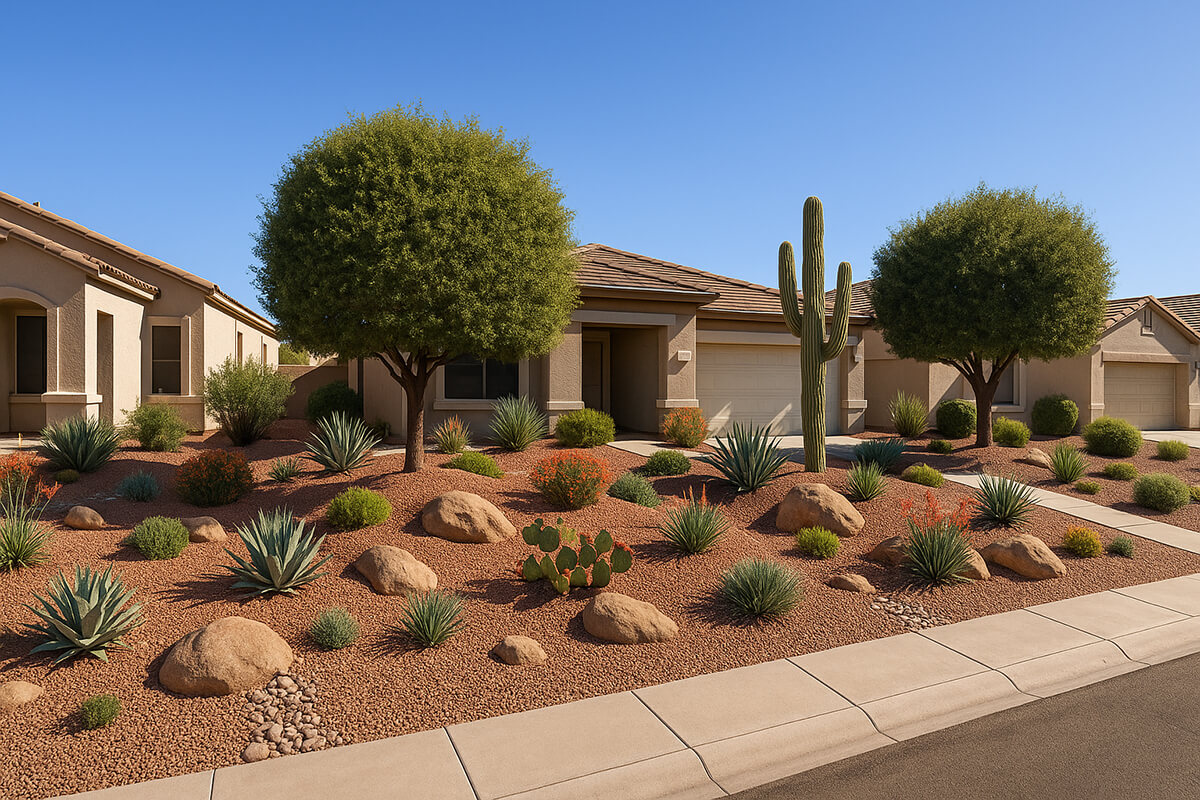
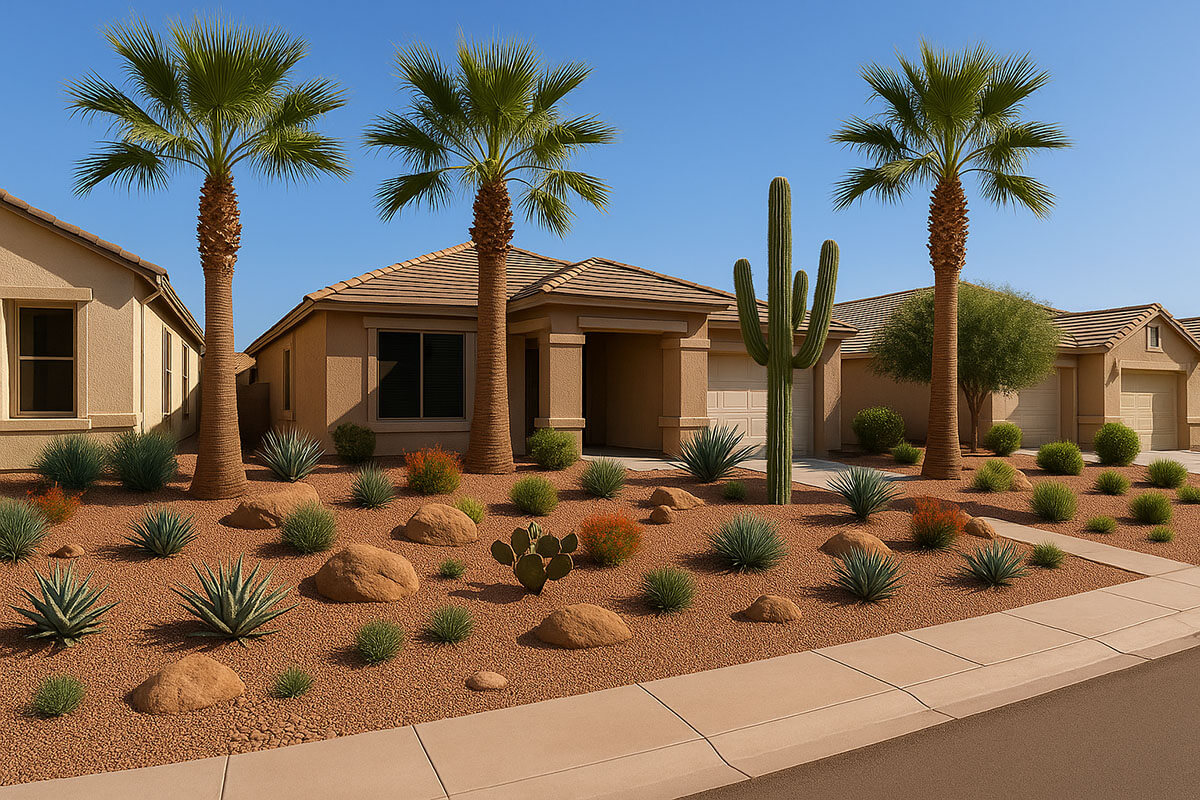
I asked ChatPGT this: "Could you remove the two large trees and replace them with three large Mexican fan palms?"
It did not do exactly what I expected, but it's pretty close. The new rendering changed some of the plant selection and removed some smaller rocks and hills. (Fig 3)
At a casual get-together with a few neighbors, I showed the AI-generated landscape design to the homeowner, who is also a friend. At first, he was surprised when I explained what I’d done—but once he saw the image, he leaned in, grabbed my phone, and said, “Holy shit!”
How AI Can Help With Landscape Design
If you're like the typical homeowner, you probably don't have much experience with landscaping or the budget to hire a professional designer. Fortunately, AI tools can generate multiple concepts quickly and at no cost. You can then use the ideas to tackle the project yourself or share them with a landscaper to handle the installation.
One of AI's biggest strengths is its ability to help you visualize ideas without needing to hire a landscape designer. You can describe your preferences, and the AI will generate renderings based on your input.
For example, the first version of the AI-generated landscape included several century plants (Agave Americana). While striking, agaves are vulnerable to the agave snout-nosed weevil, especially in Phoenix, Arizona, and Southern California.
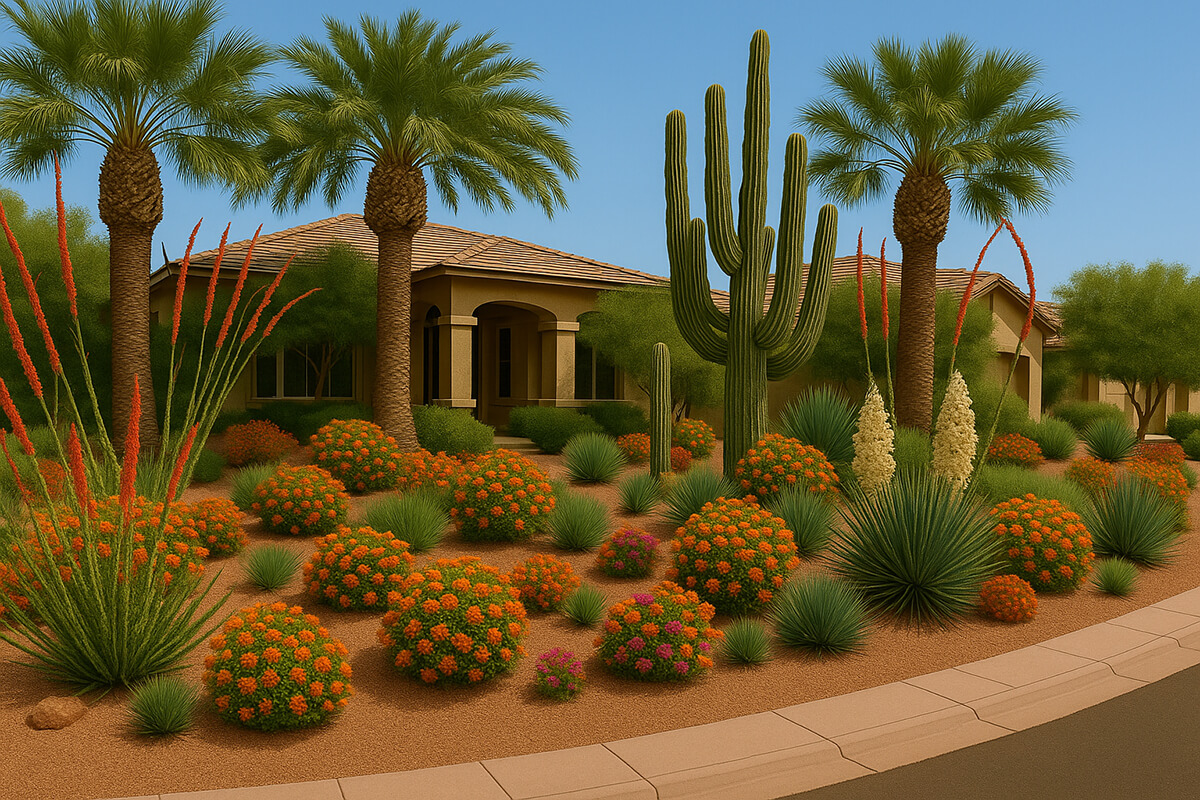
I asked ChatGPT to remove a few of the problematic century plants and add some ocotillos (Fouquieria splendens), common lantanas (Lantana camara), red and yellow yuccas (Hesperaloe parviflora). The revised image still included a few unexpected elements—a strange rampart between the houses and a disappearing sidewalk 😂, but overall, it's a good presentation. (Fig 4)
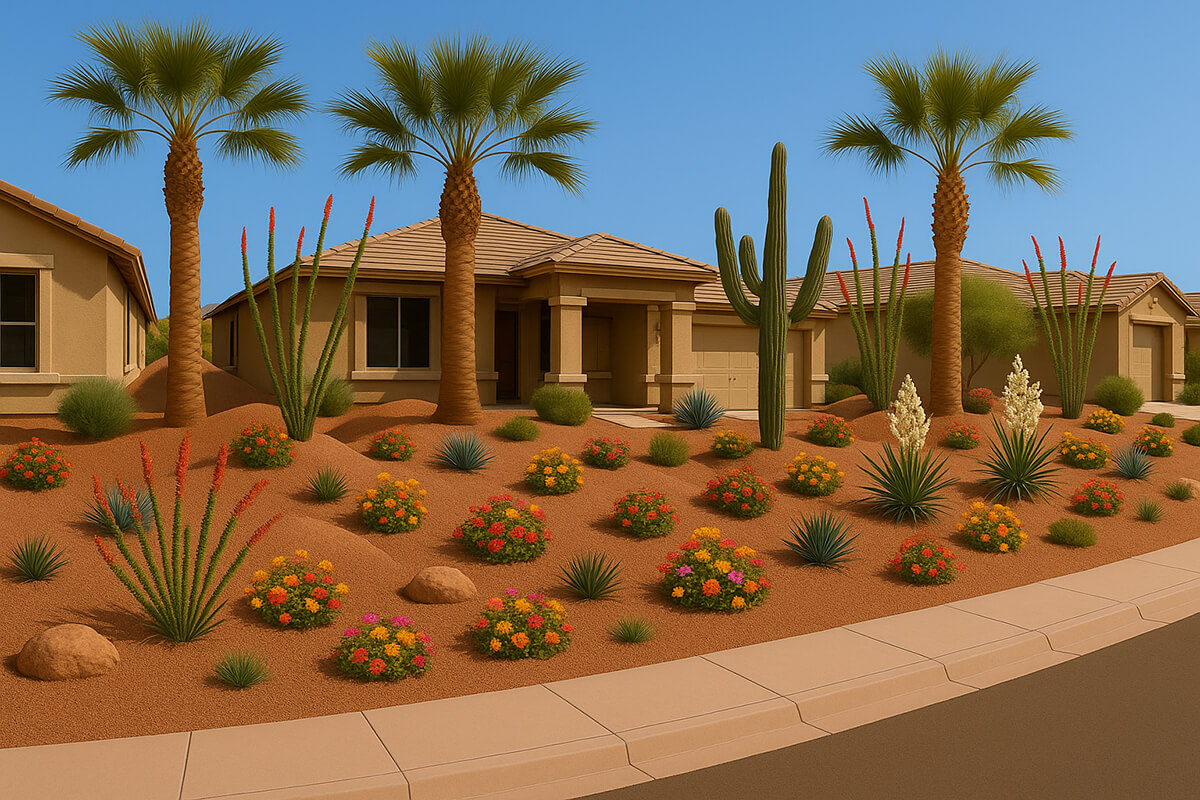
Most of the plant depictions are not entirely accurate, but that's okay! The goal is to capture the look and feel of a finished yard, allowing you to consider the viability of different plant species and your budget.
The Mexican fan palms pictured above, for example, could cost several thousand dollars. Average-sized (3 to 8 ft) saguaro cacti range from $80 to $100 per foot, and extra-large versions can cost upward of $10,000, making them too expensive for most DIYers.
Another cool aspect of AI is being able to visualize how your yard might evolve. As you plan, consider that the landscape above will look very different in 3 to 4 years. Many plant species grow year-round in the Phoenix and Southern California (SoCal) area. If you place the plants too close together, they will overtake each other in a few years, and your yard could end up looking very crowded.
With this in mind, I asked ChatGPT to create a new, mature landscape image based on the previous version. I asked, "Can you show me how this landscape will mature over four years, considering this is in Phoenix, Arizona?" The resulting image is pretty dramatic! (Fig 5)
Choosing the Right Plants for Your AI Landscape Design
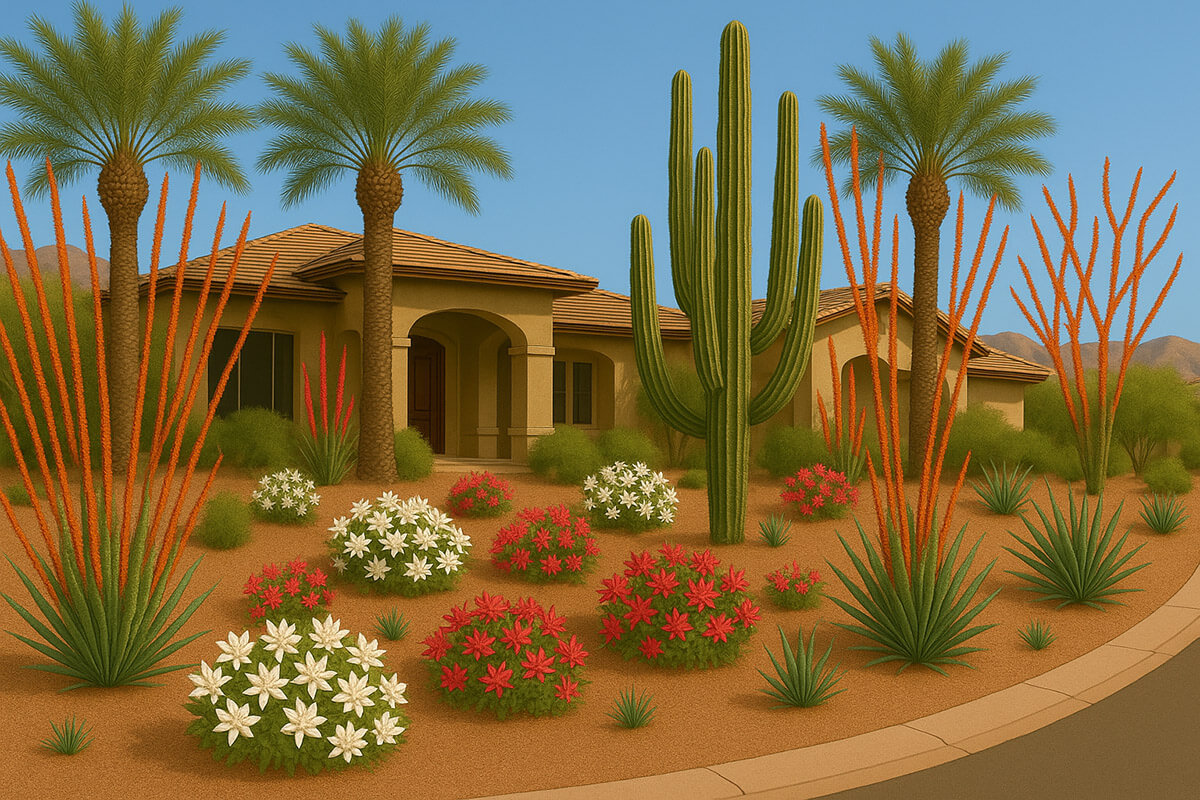
You can ask AI to include specific plant species in your design, but the results in my experiments varied. In one test, I asked ChatGPT to replace lantanas with oleanders and ocotillos.
Even though the oleanders and ocotillos are not taxonomically correct, they still represent how the finished landscape might look. (Fig 6)
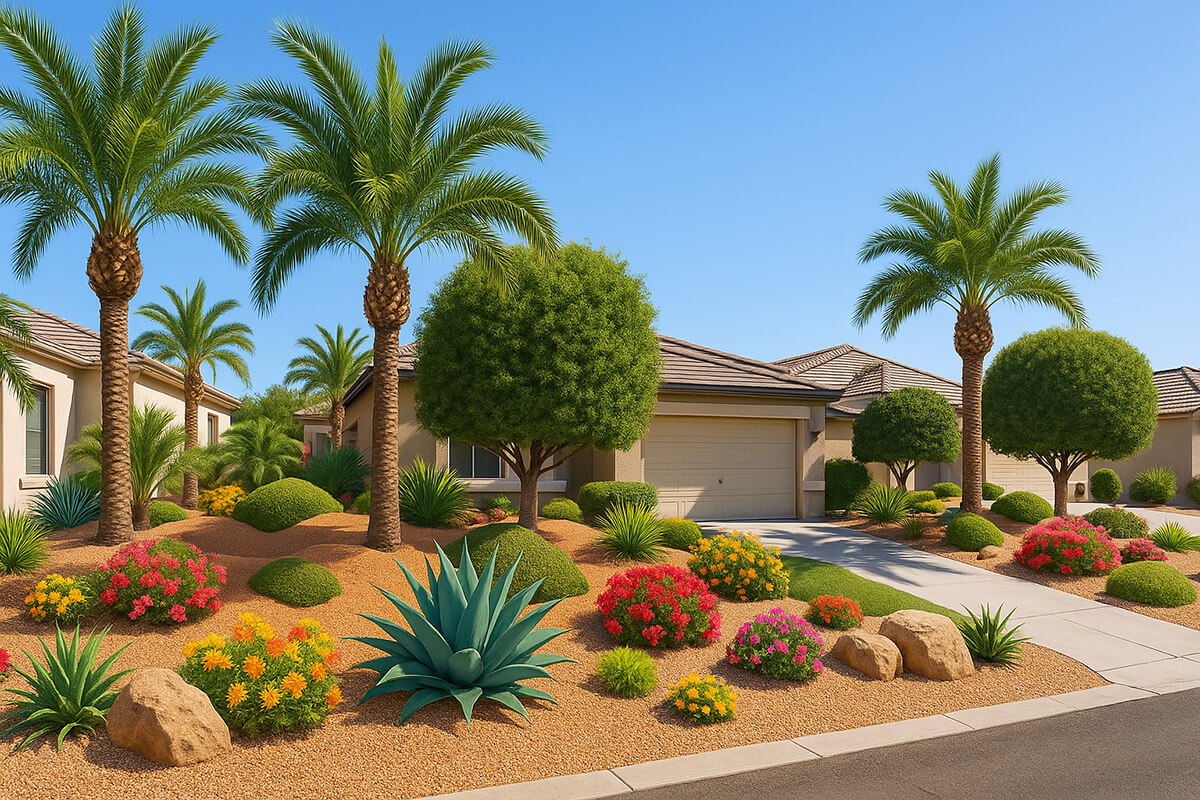
A better approach may be to use broad terms such as "cacti," "succulents," "palm trees," or simply the word "desert plants." Uploading the original photo I shot to ChatGPT, I asked, "Could you landscape the yard in this image with palm trees, gently rolling small hills, and xeriscape plants?"
The image generated was better than the first rendering ChatGPT created. Perhaps using broad terms such as desert plants or xeriscape is a better approach than asking for specific plants. It's a possibility that ChatGPT "learned" from my previous requests and used this knowledge as a reference for this landscape. (Fig 7)
When it comes to landscaping in a desert environment, stick with plants that are native to the Sonoran Desert or ones that have a solid track record in the environment in which you live. Just because you see a plant at Home Depot or Lowe’s doesn’t mean it’ll do well in your yard. Much of what both stores sell will not grow well in full sun, especially plants raised outside Arizona and shipped to the Phoenix area.
Here's a list of plants with which I've had personal success in the Phoenix area. Most are drought-tolerant and thrive in full sun, although a few require afternoon shade or partial shade.
| Species | Notes |
|---|---|
| Mexican fan palm (Washingtonia robusta) | Can suffer some leaf burn in July-Sept |
| Century plant (Agave Americana) | Needs protection from the agave snout-nosed weevil, do not water during the hottest months |
| Variegated century plant (Agave Americana marginata) | Will thrive as long as it gets some shade |
| Opuntia | Most species, including prickly pear do well in full sun |
| Barrel cactus (Kroenleinia grusonii) | Afternoon shade is best |
| Bunny ear cactus (Opuntia microdasys) | Full sun |
| Oleander (Nerium oleander) | 'Hardy Red', pink, yellow, and white, thrives in afternoon shade. |
| Common latana (Lantana camera) | Full sun |
| Red yucca (Hesperaloe parviflora) | Full sun or partial shade |
| Ocotillo (Fouquieria splendens) | Full sun, or partial shade |
| Red yucca (Hesperaloe parviflora) | Full sun or partial shade |
| Olive trees (most species, including fruitless) | Olive trees are immune to even the hottest temperatures |
| Texas sage (Leucophyllum frutescens) | Full sun or shade |
| Date Palm (Phoenix dactylifera) | Full sun |
| Saguaro cactus (Carnegiea gigantea) | Some larger specimens have suffered in recent years from high nighttime temperatures. |
| Sago palm (Cycas revoluta) | Must have lots of shade |
| Bottlebrush (Callistemon) | Grows well in any environment |
| Bougainvillea | Contrary to what is commonly mentioned, it will bloom in shaded areas, year-round - will burn in full sun (Phoenix area) |
| Mexican fencepost (Lophocereus marginatus) | Needs some shade |
| Citrus, orange, lemon, and grapefruit | Most varieties do well in full sun, although they may experience some scorching on the leaves and fruit |
| Aloe vera | Must have lots of shade, avoid over-watering |
AI is not a replacement for local expertise but a handy tool to jumpstart your landscaping vision. Whether you’re visualizing how to landscape your yard or experimenting with different plant combinations, AI can make the process easier.
Additional Resources
Native Plant Nurseries in Phoenix

Ask Me! 
Need some expert guidance? Shoot me a message, and I'll provide actionable, free advice to solve your problem.
Message Me