

The term “cactus corking” might initially evoke an image of the latest TikTok challenge. However, in botanical terms, cactus corking refers to a natural process where a cactus develops a bark-like, woody layer on its surface resembling cork bark.
Cactus corking is a physiological response that occurs as the plant matures, characterized by the formation of a hard, protective outer layer. This transformation is akin to the callous formation in humans, where repeated exposure to friction or pressure leads to the development of tougher skin.
In cacti, the epidermis (green, fleshy outer tissue) gradually becomes a rough, woody layer, often brown in color and similar in appearance to tree bark. (Fig 1)
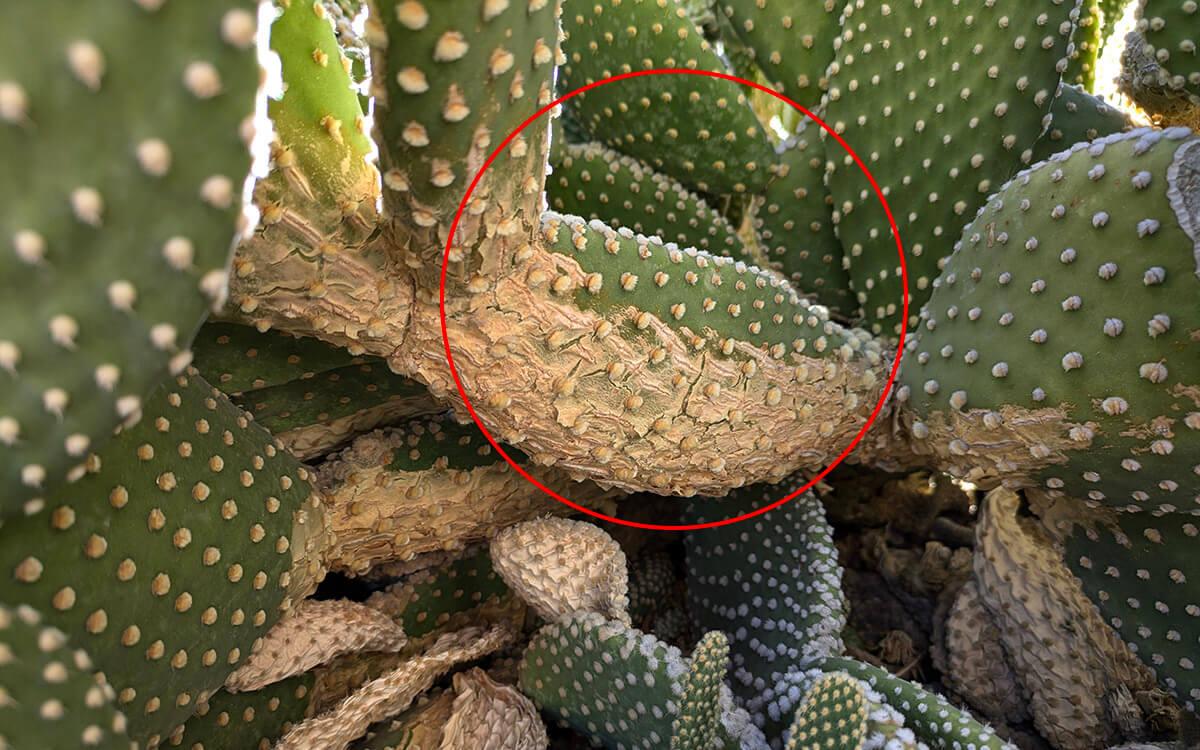
Corking is also a natural phenomenon present in many succulents and is commonplace, for example, in jade plants (Crassula ovata).
Corking is usually associated with older, more mature cacti. It's the cacti's way of ensuring they can survive periods of low precipitation and provide protection from extreme heat and UV radiation. In the Sonoran desert area, cactus corking is quite common, especially in areas where a cactus does not receive shade from trees and water is a premium.
Causes of Cactus Corking
Corking is predominantly associated with cacti's natural aging. This woody covering provides structural reinforcement and additional protection as the cactus grows. It generally begins at the base of the plant and slowly progresses upwards, allowing the cactus to withstand the challenges of its environment.
As cacti age, corking becomes more prevalent. Corking is vital for supporting the plant's growing weight and ensuring structural integrity in mature cacti, particularly larger species such as prickly pear (Opuntia) and saguaro (Carnegiea gigantea).
A large saguaro cactus can weigh in excess of several tons when fully hydrated with water. Like most cacti, the saguaro's interior is comprised of spongy-like tissue used to store water. A large saguaro can store over 1,000 gallons of water. That's in excess of 4 tons of just water!
In addition to age, external environmental factors can trigger corking. These stressors include:
- Exposure to Extreme Sunlight: Intense sunlight, particularly in regions with high levels of UV radiation, can initiate corking as a protective mechanism. For example, cacti exposed to the western sun in arid climates often exhibit corking in upper areas where the sunlight is most intense. Cacti can and do develop sunburn, just like humans.
- High Temperatures: Frequent temperatures in what is considered an extreme range can cause a cactus to develop corking as a means to protect the inner fleshy core. As of this writing, the Phoenix area has experienced 104 consecutive days of at least 100 degrees.
- Water Scarcity: Prolonged periods of drought or irregular watering can exacerbate corking. When water is limited, the corking layer reduces water loss and shields the soft, fleshy interior from drying out. The cork layer minimizes water loss through transpiration, which is crucial for survival in arid environments. By reducing the amount of water vapor escaping through the epidermis, corking helps the cactus retain moisture during droughts or periods of water scarcity.
Corking vs. Callusing
Some people, when observing a cactus, confuse callusing with corking. Callusing typically occurs after physical damage, for example, a cactus losing a pad through propagation or pruning. In this case, the callus forms a temporary protective layer, like a biological Band-Aid, preventing pathogens and insects from infiltrating the damaged area.
When, for example, you prune a bunny ear cactus, the cut area will, within a very short time, begin to develop a tan-colored callus that covers the wound. Over time, the callus will grow into an impenetrable, wood-like substance. (Fig 2)

The callus will remain for the life of the cactus. No new growth can be initiated in this area; however, the cactus solves this problem by promoting new growth from areas just below the callus.
Cactus corking, on the other hand, typically starts at the base of a cactus and slowly creeps upward as the cactus ages. Corking is an adaptation related to aging and environmental stressors. Similar to callusing, corking is a permanent structural adaptation.
It's not unusual to see both cactus corking and callusing occurring in the same specimen.
Because corking is a necessary adaptation, it's not recommended to attempt to remove the woody substance. I've read articles that describe a scraping method that can be used to remove the corking and return the cactus to its original appearance. This is totally unnecessary and could actually kill the entire cactus.
How to Distinguish Between Cactus Corking and Other Issues
Cactus corking is unrelated to diseases commonly found in cacti. Many cacti owners commonly assume corking is associated with a disease or some other biological response that means the plant is sick.
The easiest way to tell the difference between cactus corking and other issues is to gently press with your finger in the area that resembles cork. If the flesh is firm to the touch, the cactus is most likely experiencing corking. If the cactus is soft to the touch or mushy, this is rot, most likely due to over-watering.
Like every plant, cacti need water to survive, but they can rot or crack when provided with too much water. Cracking occurs because the cactus is attempting to store more water than it can hold. Once it has expanded beyond its limitations, cracks will form in its epidermis. Too much water can also cause the root system to rot or suffocate the plant because the excess water displaces oxygen in the soil.
Underwatering a cactus can cause desiccation, which, in some cases, is confused with corking. A cactus suffering from desiccation will appear dry and brittle. High temperatures can amplify desiccation, especially when a cactus is exposed to direct sunlight.
Desiccation is a self-protection mechanism by which a cactus attempts to protect itself until conditions improve. If it does not receive water, it will eventually die.
Desiccation is the process of a plant drying up. It can occur in any plant. Depending upon the severity of desiccation, a plant may be able to recover or tolerate periods of little to no available water.
Sunburn, especially in areas of the Southwest United States, is quite common in newer cacti that have not acclimated to direct sunlight. A cactus can suffer permanent sunburn in as little as a few hours. Differentiating between sunburn and corking is quite simple. Sunburn appears very quickly, unlike corking, which can take years to develop. (Fig 3)

Sunburn is usually noticeable in the area of a cactus facing the sun. It appears as a bleached section on a cactus. (Fig 4) Eventually, the bleaching can turn to a brown scar that will remain for the duration of the cactus's lifespan. Amazingly, even an area that is sunburned can recover and sprout new growth, as shown in the above photo.

If you notice sunburn or scarring, cover the cactus with sun-blocking material such as Agfabric sunblock shade cloth or move the cactus to a shaded area. Left for too long in direct sunlight, sunburn will kill a cactus.
Additional Resources
Science Direct: The structural and nutrient chemistry during early-stage decomposition and desiccation of cacti in the Sonoran Desert
NIH: Structure-Function Relationships in Highly Modified Shoots of Cactaceae

Ask Me! 
Need some expert guidance? Shoot me a message, and I'll provide actionable, free advice to solve your problem.
Message Me