

The bunny ear cactus (Opuntia microdasys) is incredibly easy to grow and just as easy to propagate. (Fig 1) To propagate a bunny ear cactus, you need a donor plant or someone willing to give you a pad.

Despite what others commonly mention, the bunny ear cactus grows extremely fast, provided it receives plenty of sunlight. Left unpruned, it will overtake any plant in its path.
Besides spreading outwards, the bunny ear cactus will grow vertically, up to a point where it will topple over, breaking other portions of the cactus as it falls. You can mitigate some of this by using plant stakes to help support the tall growth. (Fig 2) Eventually, however, these sections will break off.
The bunny ear cactus is native to most areas of México. It can also be found in Phoenix and Tuscon, Arizona, Southern California, and El Paso, Texas.
The bunny ear is a ground-cover type of cactus that prefers sandy soil. It is extremely drought tolerant and easily spreads when pads break off from the main plant and start growing. It's an excellent choice for xeriscaping, a process of using plants that require little to no water beyond what the climate provides.
The bunny ear gets its name because pads often grow in pairs, giving the appearance of bunny ears.

Propagate a Bunny Ear Cactus
The process is simple! Don't worry about possibly killing the pad(s) you remove. It's almost impossible! As long as you provide the new pad(s), water, and soil, the bunny ear will begin to form roots (and new pads). This exact process is used to propagate prickly pear cactus, a cousin of the bunny ear cactus.
Before you begin propagating a bunny ear cactus, there are a few things to be aware of.
No special care is required if you take cuttings from a donor plant to propagate a bunny ear cactus. The cactus will form a callous in the area you cut, effectively sealing the wound from disease and pests. (Fig 3) In a short time, several new pads will grow from the area surrounding the cut on the donor plant.

There is no need to wait for the pad(s) you removed to callous. I've read elsewhere that letting a callous form is necessary to prevent the pad from rotting. This step is entirely unnecessary! I've taken pads that have broken off from the main plant, stuck them in the ground, and forgot about them.
Unless you saturate the soil with water, the pad will not rot. If it does begin to develop a little rot, cut off the rotten portion of the pad and place it back in the soil.
Before you begin, have a pair of thick leather gloves ready. You can also use canvas gloves, but canvas tends to allow some extremely fine glochids (spines) to penetrate the material.
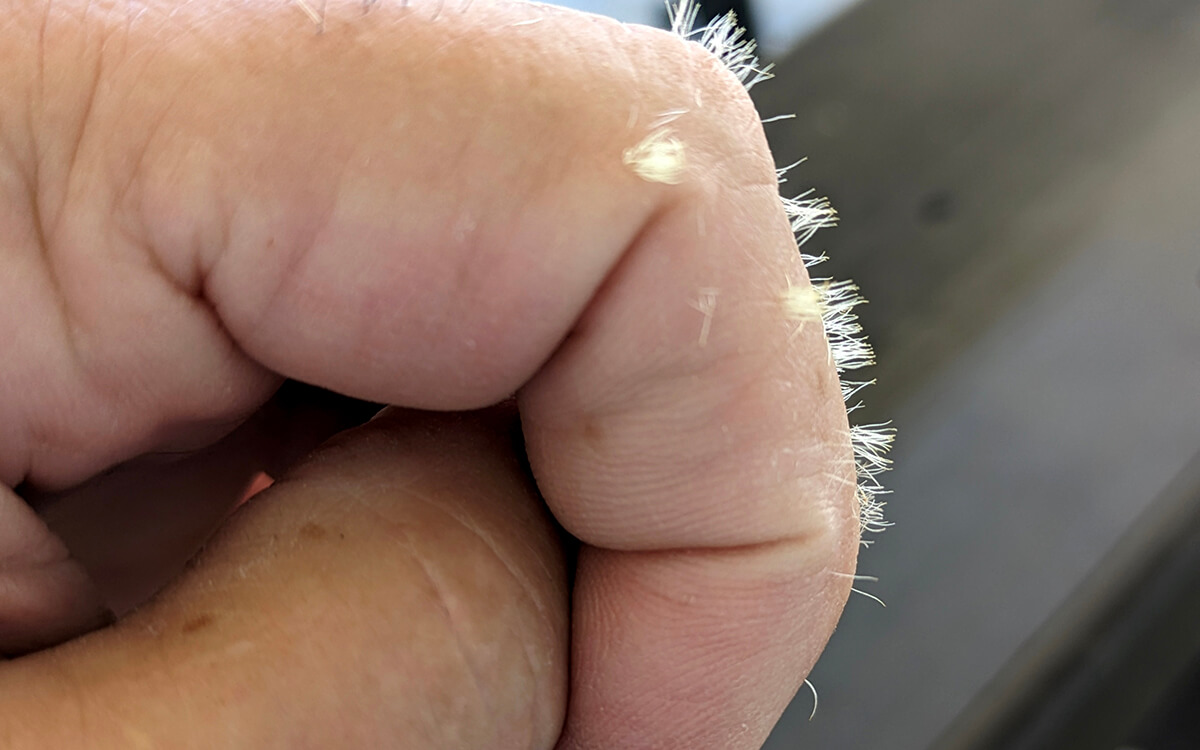
Glochids that penetrate your skin are difficult to remove and cause an extremely annoying itching sensation—no bueno! (Fig 4) If you've never brushed against a bunny ear cactus, it's nothing compared to a cactus with large spines. Instead of a single large spine lodged in our skin, you can expect hundreds of small glochids to penetrate your hands.

The glochids are easily dislodged. Just touching a single pad can send thousands of "tiny spears" into the air.
The easiest way to remove glochids from your skin is to use a rough (dish) scrubbing pad. Hold your hand under running water and use the pad in a gentle scrubbing motion to dislodge the glochids. This will not remove all of them, but it will bring some relief.
If you find glochids stuck in your hands and fingers, be mindful of touching other body parts. (Fig 5) I once visited the bathroom, forgetting that glochids were stuck in my fingertips. ¡Ay caramba!
With your gloves on, grab a hacksaw or a large knife and remove (cut) a single pad or a pad with multiple (child) pads.
Place the pad in the soil just enough to keep it from falling over. Fill the hole with the remaining soil, gently pressing downwards to compact it. If the pad has trouble standing upright, place a few plant stakes on either side of the pad.
Next, add a few ounces of water to the soil surrounding the pad. Continue watering the bunny ear every 7-10 days. Adding water is okay if the soil feels dry (or the pads appear shriveled). Avoid over-watering, which may cause the pad to develop rot.
After several weeks, the pad will develop a root structure. The pad won't grow larger than its original size; however, it will begin to sprout new pads as it becomes more established. Once the new pads are fully developed, they will grow new pads. The process will continue until you either remove (cut) the pads or the pads break off naturally.
If you intend to plant your cactus indoors, make sure you purchase soil formulated especially for cacti (and succulents). Never use potting soil designed for house plants. Potting soil intended for house plants is designed to retain moisture. Cacti are extremely vulnerable to rot caused by too much water.
If planting outdoors, it's a good idea to replace some of the soil with cactus soil you purchase unless you live in an area where cacti are commonly found growing outdoors. The bunny ear, like most cacti, prefers sandy soil.
Care and Maintenance—Bunny Ear Cactus
Bunny ear cacti are incredibly resilient. However, pick an area that receives full sun when choosing a location. If you plant it in an area that receives mainly shade, it will grow very slowly (or not at all). Otherwise, it's a very fast-growing cactus.
If you live in an area that is warm most of the year, the cactus must be trimmed (once it reaches a few years old) every few months unless you want it to take over your yard.
Once established, water the bunny ear about once a week between April and October. During periods of heavy rain, check the plant to ensure the soil has not gotten saturated to the point where the cactus begins to rot. In some cases, it may be necessary to uproot and replant it in an area with better drainage.
If planting indoors, place the potted bunny ear in a location that receives direct southern exposure. (Fig 6) The cactus needs more light if you notice elongated pads on the new growth after a few months. This phenomenon is known as etiolation and is an attempt by the cactus to get more sunlight.
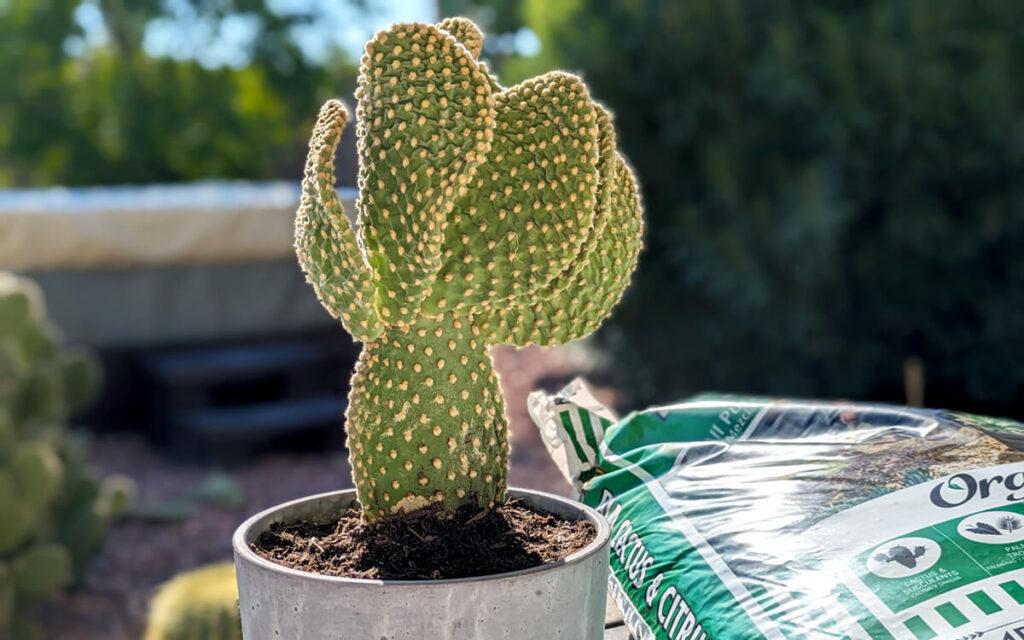
If possible, move the cactus to an area of your home with more sunlight or place it outdoors. The bunny ear is not tolerant of cold temperatures but will survive freezing temperatures for a few hours if they occur infrequently. As defined by the USDA plant hardiness zone map, the bunny ear does best in zones 9a to 11b.
The Phoenix, Arizona, area typically experiences a few nights when temperatures drop as low as 32 degrees Fahrenheit. The bunny ear cactus will be fine if the temperature does not remain at 32 degrees for more than a few hours. (Fig 7)

The bunny ear is an essential refuge for reptiles. Small lizards such as the Sonoran spotted whiptail and the keeled rock gecko will make their homes inside the tangled chaos of the pads. The cactus provides shade and protection from hungry birds.
It's common to see geckos emerge from the safety of the bunny ear cactus and scamper across my patio at dusk. (Fig 8) They skillfully climb the porch's stucco walls, waiting for an unfortunate insect to stumble into their path.

In the spring, the bunny ear cactus produces beautiful, paper-like, yellow flowers that last only a day, closing late afternoon. (Fig 9, 10) Each pad can have many flowers throughout the spring and into summer. Flowering is less common in cactus grown indoors.


The flowers will eventually form into edible purple-colored fruit that is yellow when fully ripe (during late summer). (Fig 11) Fruit production seems to be rare. I have yet to harvest a single piece of fruit.

Typically, several weeks after the flowers have bloomed, the tube-like (stems) structures from which the flower emerges drop to the ground.
Pollination occurs through self-pollination when pollen from the anther transfers to the stigma from the same flower. Pollination can also happen with the help of insects, but it is unnecessary. The wind currents provide most of the pollination.
Self-pollination occurs when pollen is transferred from the anther to the stigma on the same flower or another flower on the same plant. Cross-pollination is the transfer of pollen from the anther of a flower to the stigma of a flower on a seperate plant of the same species.
The flowers of the bunny ear cactus (and the prickly pear cactus) are very attractive to the cactus bee (Diadasia rinconis). (Fig 12) It's not uncommon to see dozens of territorial male bees darting from flower to flower in a competitive game in which they attempt to keep other male bees from landing on a flower.

Only found in Northern Mexico and the Southwestern United States, the cactus bee resembles the honey bee in appearance. Unlike honey bees, the cactus bee is a solitary insect that lives in small underground tunnels, where it raises its young.
Where to Purchase a Bunny Ear Cactus
If you want to purchase an entire bunny ear cactus rather than wait for a propagated cutting to grow, purchase options differ depending on where you live. Most nurseries in the southwest United States, including Home Depot and Lowes, have them in stock throughout the year.
If you can't locate a bunny ear at a store near you, Etsy is a fabulous resource for bunny ear cactus, including a few vendors that offer larger, bare root specimens.

Ask Me! 
Need some expert guidance? Shoot me a message, and I'll provide actionable, free advice to solve your problem.
Message Me